MoneyPlan · Drops of Memories

December's balance, seen today.

MoneyPlan doesn't log what you already spent: it projects what's ahead. Enter income, expenses and cash, and read what you'll have left month by month — all the way to the end of the plan.

  • Try it, it’s free
  • No account
  • Your data stays on your device
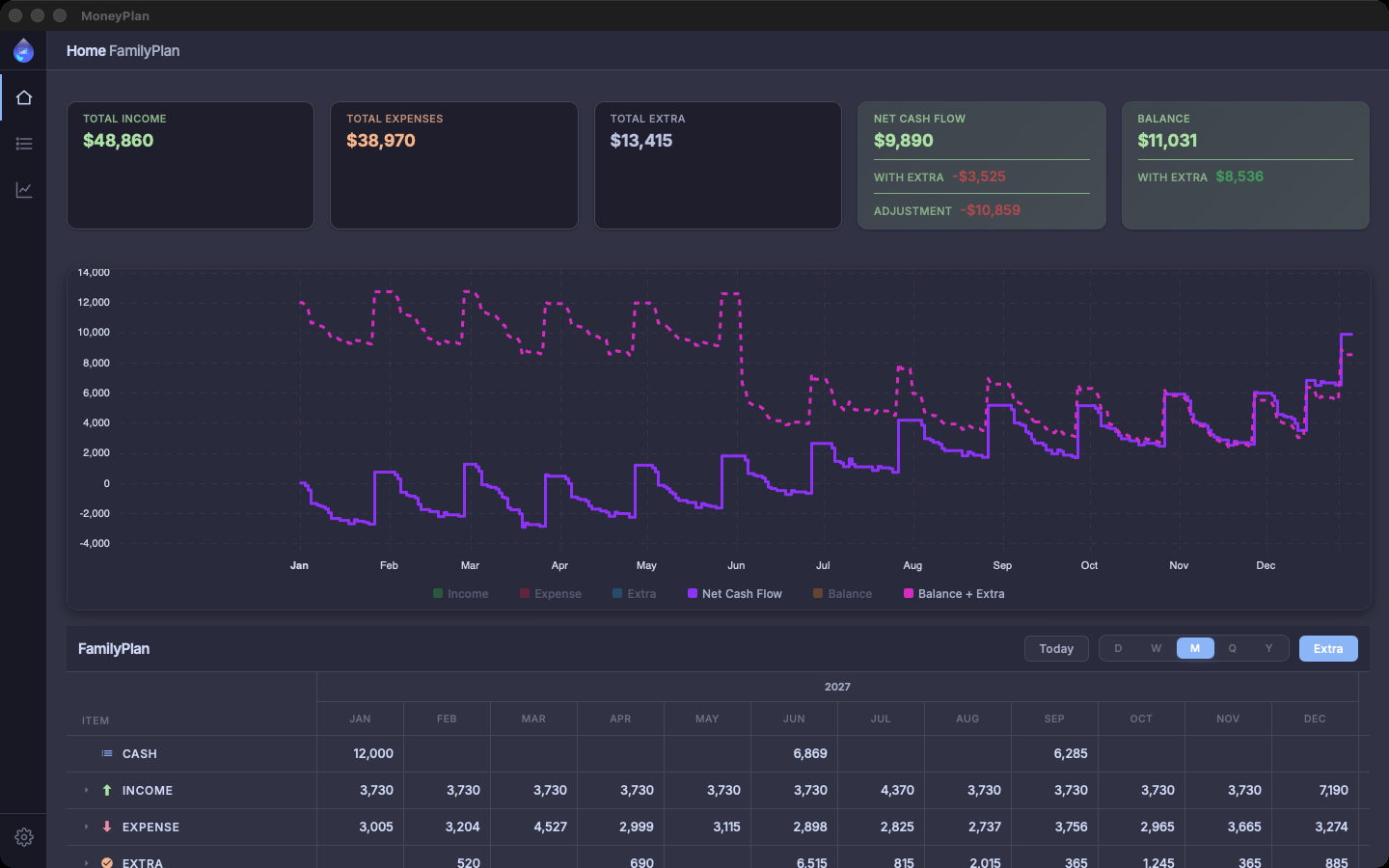
MoneyPlan on Mac: the FamilyPlan 2027 plan with the summary cards — income $48,860, expenses $38,970, extra $13,415, net cash flow $9,890, balance $11,031 — the projection chart and the monthly sheet
A year of planning in one screen: the Balance card says $11,031, and $8,536 with Extra. You know it in January.
Income
$48,860
Expenses
$38,970
Net cash flow
$9,890
Balance
$11,031
Your account says what you have today.
About December, it says nothing.

Changing the car, redoing the bathroom, putting a child through a school that costs, getting through a year with one more instalment: money decisions get made by looking at today's balance. But the real question is a different one — if I do it, what's left in December?

MoneyPlan answers that question. With your numbers, not by feel.

The demonstration

A family's year, projected in front of you

A salary that lands every month, the mortgage, the groceries, the school canteen, the fuel, and in June an Extra of $6,515 still to decide on. Two hundred and forty-two entries in a year. Every screen below is the real app, with these numbers.

Balance projection

Not the flow: the balance, month by month

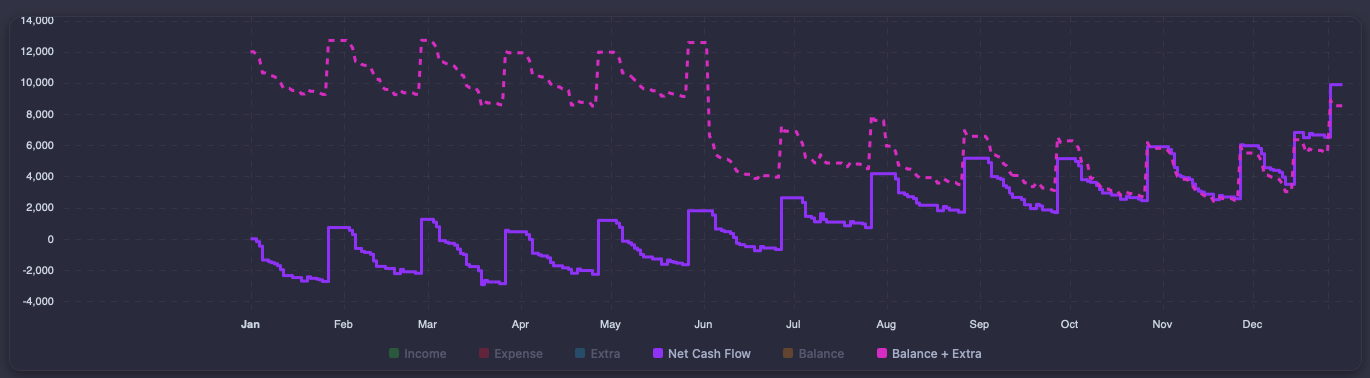
Pick a start and an end date — months or years — and the plan projects the whole period. The cards at the top sum up the year: $48,860 of income, $38,970 of expenses, Net Cash Flow $9,890. The chart keeps the two lines that matter on screen: Net Cash Flow month by month, and Balance + Extra dashed above it. The other series switch on and off from the legend.

Close-up of the projection chart: the solid net cash flow line swings between −4,000 and 6,000 dollars, the dashed balance plus extra line stays higher, from January to December 2027
The projection chart: net cash flow and Balance + Extra, twelve months in one line.

Where the money goes

The year's total, then category by category

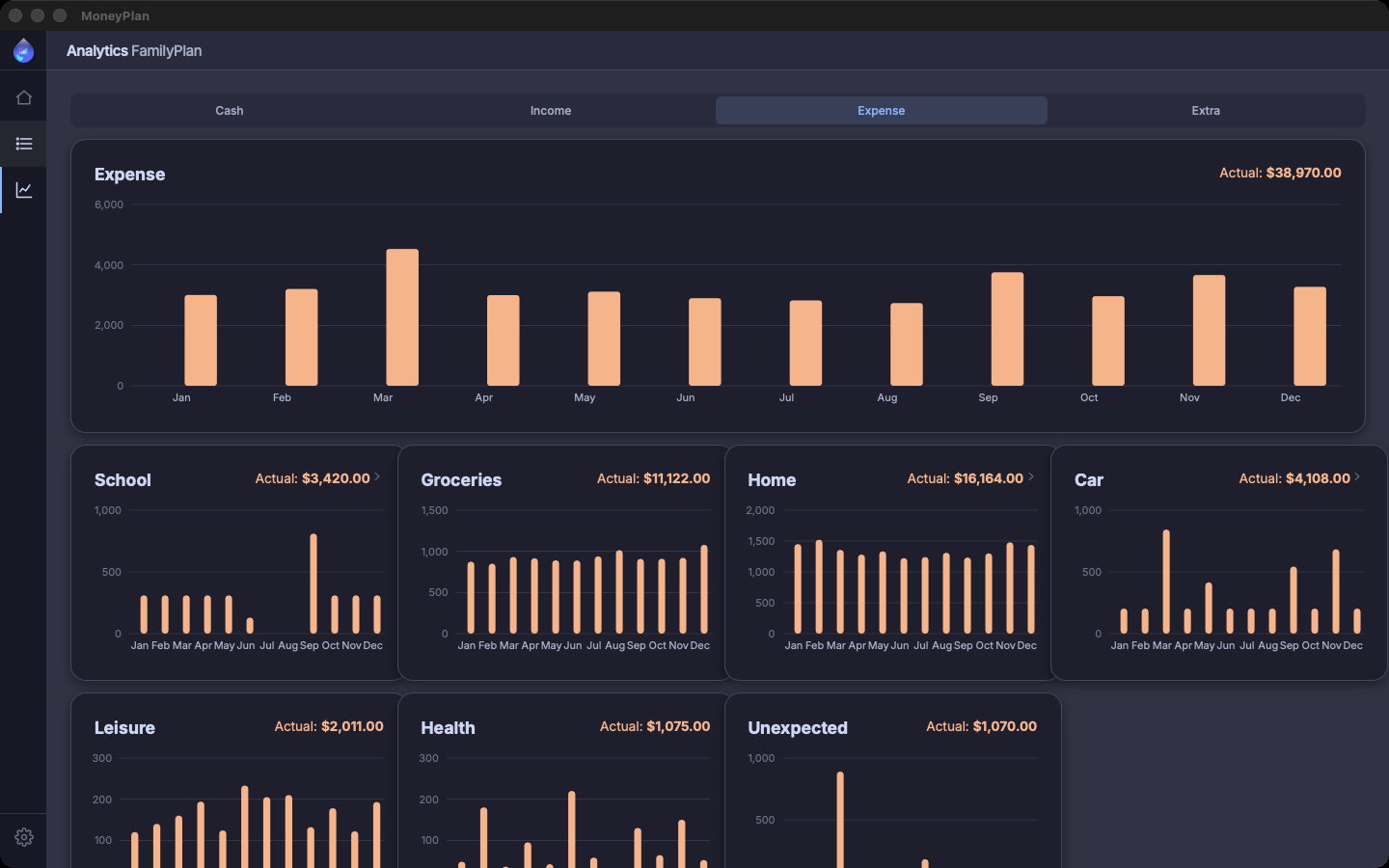
The Analytics view splits the plan into Cash, Income, Expense and Extra. On Expense: $38,970 for the year, and below it the categories one by one — home $16,164, groceries $11,122, car $4,108, school $3,420. Each has its own monthly bars: March sticks out, and you see it before you read the number.

Analytics view on Expense: monthly bars for the $38,970 total and, below, one card per category — school, groceries, home, car, leisure, health, unexpected — each with its own chart
The year's Expense and the seven categories that make it up, each with its own shape.

Any granularity

From the day to the year, in one click

The same projection reads by day, week, month, quarter or year — the buttons at the top right. Next to them, a switch turns Extra on and off across the whole table. In the monthly sheet the Cash row carries $12,000 in January plus the two checkpoints in June and September; Income sits at $3,730 almost every month; Expense swings between $2,737 and $4,527.

Header of the monthly sheet with the day, week, month, quarter and year buttons, the Extra switch, and the Cash, Income, Expense and Extra rows across the twelve months of 2027
The plan sheet: granularity changes from here, and the table recomposes underneath.

Cash

The projection doesn't drift blind

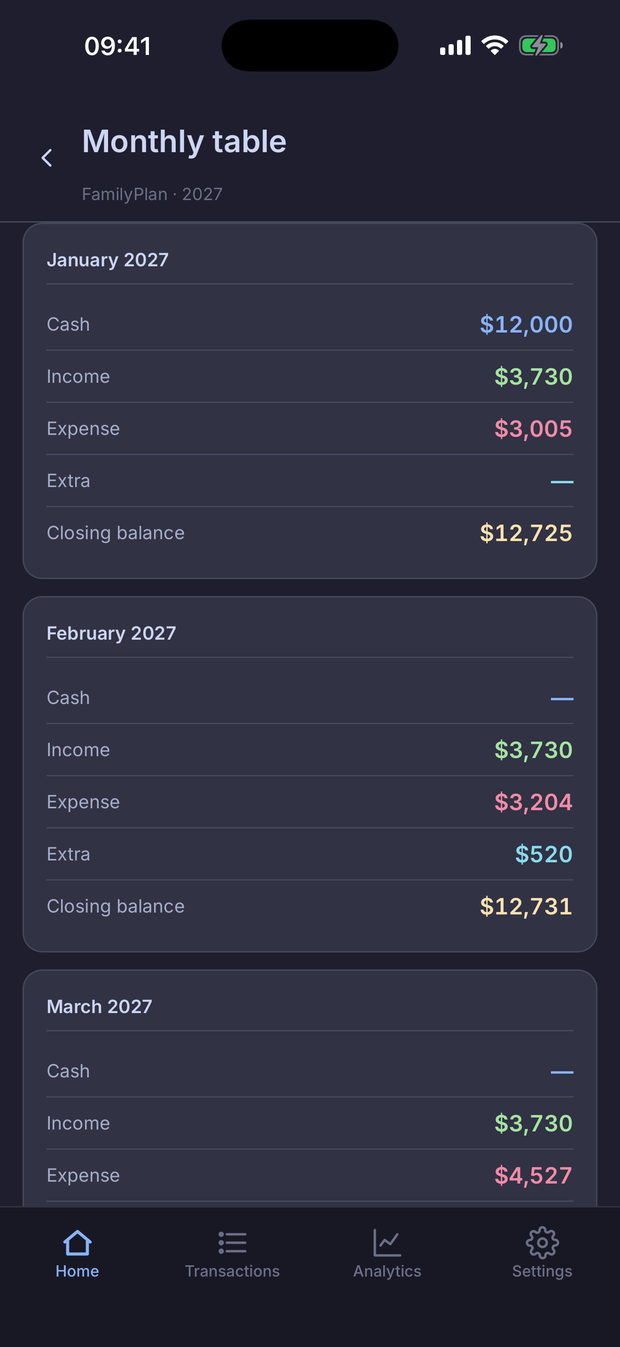
Every so often you enter the real cash you hold on a given date, and the plan realigns from there on. January: Cash $12,000, Income $3,730, Expense $3,005, no Extra — closing balance $12,725. It's the anchor that keeps the projection tied to what's actually in your account.

See what the decision does, before you make it

The things you'd like to do but haven't committed to go under Extra, and the plan keeps the two sets of numbers apart. Two figures, one question: Net Cash Flow +$9,890 without Extra, −$3,525 with it. Does it fit?

Monthly table on iPhone: January 2027 with cash $12,000, income $3,730, expense $3,005, no extra and a closing balance of $12,725; February with an extra of $520
January closes at $12,725; in February an Extra of $520 lands and the balance moves with it.

Transactions

The detail when you need it, the picture when you don't

Two hundred and forty-two entries across the year, grouped by month with the totals at the head of each group: January has nineteen, +$3,730 in and −$3,005 out. Above them, filters for Income, Expense, Extra and Cash, and a search across the notes: the mortgage instalment, the supermarket, the canteen, the tank of fuel.

The 2027 transaction list grouped by month, with January expanded: opening cash of $12,000, then sports, groceries, mortgage, fuel, phone, canteen and child benefit
January open: the opening cash at the top, and the nineteen entries of the month below.

Everything you've seen is the app as it is. Open it on your own numbers: it's the fastest way to tell whether it's for you.

After the download

The first five minutes

1

You create a plan

A name, a start date and an end date. Six months, a year, three years: the horizon is yours to pick.

2

You enter what you know

The income and expenses you already know about, and today's cash. No mandatory import, no bank connection.

3

You read the future balance

The chart and the sheet fill themselves in. The question “what's left in December?” has an answer.

Then the plan grows with you: you add entries, realign the cash, try out the Extra.

Multiple plans

Work on one side, the family on the other

Separate plans inside the same app: the business here, the household there. A freelancer who keeps the two sets of books apart doesn't have to choose which one to look at.

Interface in English and Italian, light and dark theme, localised currencies and date formats.

Businesswork · invoices, taxes and contributions, professional costs
Familyhome · mortgage, groceries, school, car, the unexpected

MoneyPlan Pro

Three plans to try it. Then it’s your call.

MoneyPlan is free to download and free to use, and in the first three plans you read the projections in full. When you need a fourth — or you want to bring in the numbers you already keep in a spreadsheet — the app offers you Pro.

Free Up to three plans, with full projections.
MoneyPlan Pro Unlimited plans and Excel import.

Pro is a single purchase in the store, once: no subscription. You buy it inside the app, not from here, and it applies to the store you downloaded from — buy it on the Microsoft Store and you won’t find it on the App Store, or the other way round.

Local-first

Your numbers stay yours

MoneyPlan works on the numbers you type in, and those numbers never leave your device. It doesn't recommend investments and it doesn't give advice: it projects, and the decision stays yours.

Does that June Extra fit? Look at it, before you decide.

Download MoneyPlan, open a plan on your own numbers and read December's balance. Five minutes, no setup.